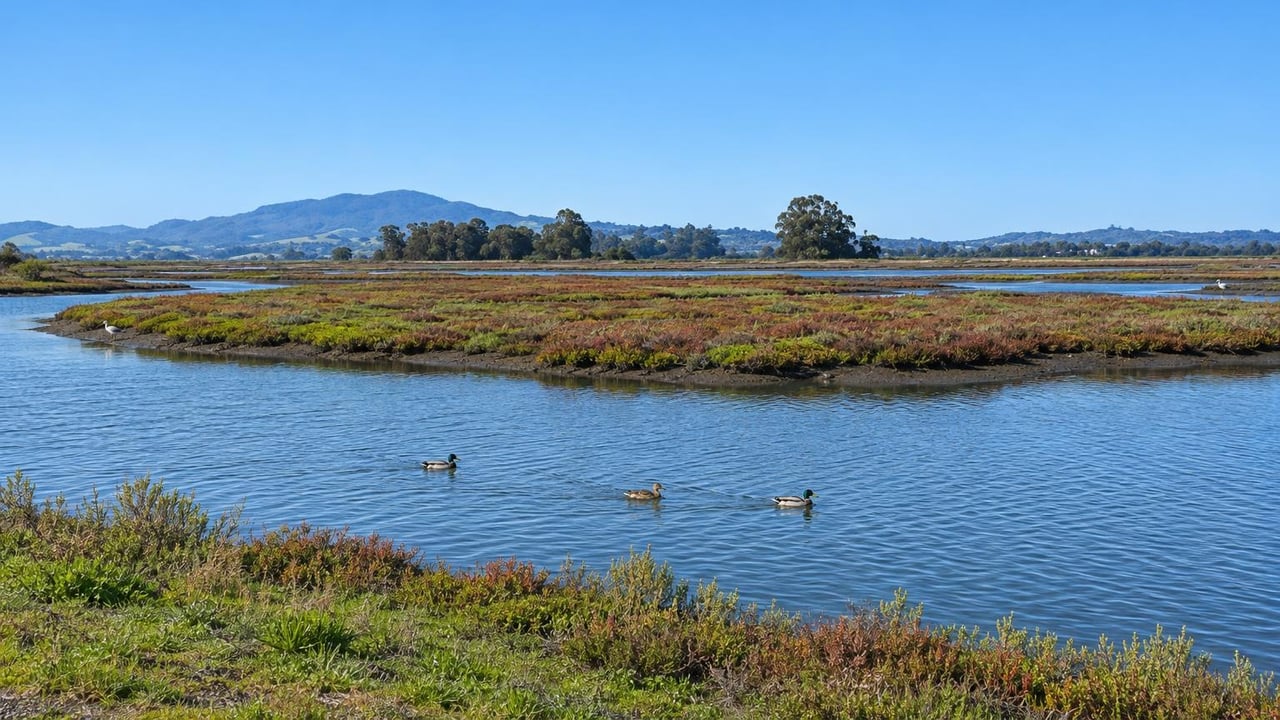
In April 2014, crews breached the bayside levee at the old Hamilton Army Airfield. For the first time in more than 100 years, San Pablo Bay moved onto ground where military planes once took off. Two months later, 2.7 miles of new public trail opened along the edge of the new marsh. Point Blue Conservation Science now counts more than 200 bird species there and calls the site a key resting and wintering area for tens of thousands of migratory birds.
The best winter walking in Novato is on marsh that was dry land not long ago. Bahia, Hamilton and the Rush Creek shoreline are young places that are still taking shape, and the work isn't done. If you walk them between now and February, you're watching wetlands get built, one tide at a time.
Deer Island is the old baseline
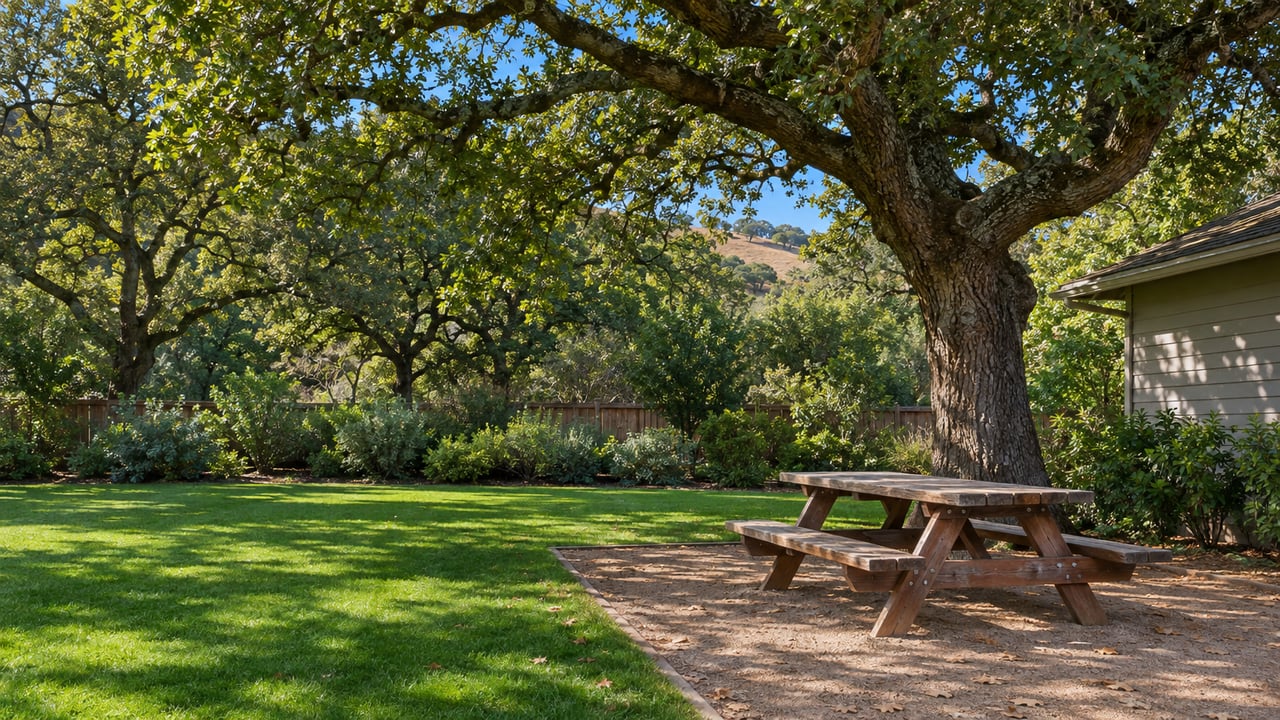
Deer Island Open Space Preserve is what the edge of Novato looked like before anyone needed to restore it. Its oak woodland rises above the marshes along Novato Creek. Marin County Parks lists snowy egrets, great egrets and American white pelicans in the wetlands and woodpeckers, owls, juncos and towhees in the trees. The entrance is off Olive Avenue by way of Deer Island Lane, and there's a small dirt lot by the gate.
The local blog Nature in Novato has logged sparrows and meadowlarks in the grasslands there in winter, along with kinglets and yellow-rumped warblers in the woods and ducks, grebes, coots and raptors near the ponds. That makes it a good place to start, because it shows what the newer marshes are working toward.
Bahia went from pumped fields to tidal marsh in five years
For many years before 2003, the diked baylands around the Bahia neighborhood lay fallow and were pumped dry at the end of each rainy season, according to Marin Audubon Society's newsletter The Rail. Marin Audubon bought the 632-acre property in January 2003 with money from public agencies, foundations and private donors. The 361.7 acres of diked bayland were deeded to the Wildlife Conservation Board and the 208 acres of oak woodland to the Marin County Open Space District.
In 2008, Marin Audubon restored almost 355 acres to tidal marsh. Levees were breached and channels dug across 139 acres of Central Bahia. More breaches in 2013 connected Black John Slough to the 216 acres of West Bahia. When the newsletter reported on year 10 of monitoring, it said all four surveys up to then had found the marsh "maturing well."
The tide tells you what you'll see from the trail. In Marin Audubon's description of the site, thousands of shorebirds come down to feed on the mudflats when an ebbing tide exposes them. On a flood tide, hundreds of ducks and some gulls float and forage. Nature in Novato has reported large flocks of common goldeneyes on Bahia Lagoon in winter, plus Barrow's goldeneye, bufflehead, mergansers, egrets and the occasional white pelican.
The hill above the marsh has its own story. Marin Audubon calls the Bahia uplands the only known place where a blue-oak-dominated woodland sits next to salt marsh. That parcel is now part of Rush Creek Preserve, and a public trail connects the two. In winter the woods hold oak titmice, white-breasted nuthatches, Hutton's vireos, at least four kinds of woodpeckers and many sparrows.
To get there, take Atherton Avenue east from Highway 101 and bear left at the Y onto Bugeia Lane, which turns into Bahia Drive. Drive to the bottom of the hill and park along either side of the road. The trailhead is on the north side.
Rush Creek is where the two kinds of walk meet
Since the Bahia uplands joined Rush Creek Preserve, you can walk from the new marsh to the older shoreline without getting back in the car. The main Rush Creek entrance is on Binford Road off Atherton Avenue, and the county says roadside parking there is usually ample. At the Bahia entrance, parking is on the street only.
Nature in Novato's site guide lists the wintering shorebirds along Rush Creek as sandpipers, dunlins, yellowlegs, dowitchers, willets, godwits, whimbrels and curlews. Its duck list is pintail, canvasback, shovelers, wigeon, teal, ruddy ducks and buffleheads. That's a birder's record of what has turned up over the years, so treat it as a list of possibilities for any given morning. Marin County Parks warns that Rush Creek's trails can be muddy in the rainy season.
Hamilton was built from the bottom of the Bay
The 2014 breach at Hamilton came after years of hauling dredged sediment from San Francisco Bay to raise an airfield that had sunk below the land around it. The U.S. Army Corps of Engineers puts the total at 5.8 million cubic yards, including 3.5 million from the Port of Oakland's 50-foot deepening project. The State Coastal Conservancy gives the figure as 6.1 million cubic yards for the 648-acre restoration. Either way, the marsh plain you look across from the levee trail was dug from shipping channels and harbor bottoms.
The Corps' monitoring of the Hamilton marsh runs through 2027, 13 years after the breach, so this winter is one of the last in that tracking period. The next-door Bel Marin Keys Unit V parcel is 1,612 acres, and the Corps says up to 13.8 million more cubic yards of dredged material could go there.
Nature in Novato's Hamilton guide lists wintering avocets, stilts, curlews, whimbrels, godwits, dowitchers, sandpipers, dunlins and plovers. Kites, peregrines and harriers hunt over the marsh. The San Francisco Bay Trail describes two ways onto the levee-top trail. One is from Hamilton Parkway near Palm Drive by way of the Reservoir Hill Trail. The other is from Hangar Avenue near Maybeck Street, where you park by the ballfield. If you have kids along, the Hamilton neighborhood also has the Amphitheater Park playground project we covered in October.
The next chapter could double Bahia
The marshes are still growing. In February, the Marin Independent Journal reported that the State Coastal Conservancy had voted unanimously on Feb. 19 to give Marin Audubon $2 million from the 2024 Climate Bond. The money will help Marin Audubon buy two former tidal marshlands covering more than 300 acres. The plan is to roughly double the size of the Bahia wetlands and create a continuous corridor of tidal habitat from Novato through the Petaluma Marsh along the Petaluma River.
In September, a Conservancy staff recommendation dated Sept. 17, 2026 proposed up to $2.5 million for Point Blue. The money would pay for two more years of care on about 177 acres of restored wetlands in the Novato Baylands. That work includes community engagement and improvements to public access amenities.
When the marsh is too wet, go uphill
When rain soaks the bay edge, Novato's hills have their own winter draws. At Mount Burdell, Marin County Parks notes amphibians at Hidden Lake during the rainy season. Parking is street-only at the San Carlos Way, Fieldstone Drive and San Andreas Drive entrances. Indian Valley has a waterfall that runs in the rainy season and amphibians at its pond. The western entrance is reached by way of South Novato Boulevard, Arthur Street and Indian Valley Road. The eastern entrance goes through the College of Marin campus, where parking may cost a fee. Nature in Novato describes the Waterfall Trail as a winter walk. The same guide has noted pileated woodpeckers in the preserve and varied thrushes in the dark woods near the Schwindt Trail.
As of its Nov. 19 update, Marin County Parks' alerts and closures page listed no closure specific to Deer Island, Rush Creek, Mount Burdell or Indian Valley.
December dates for the calendar
On Saturday, Dec. 5, Marin Audubon is holding a guided walk at Bahia from 9 a.m. to noon with Jim White and Bob Battagin. They're calling it their "One Year Anniversary Field Trip." Registration opened Wednesday, Nov. 25 at 8 a.m. and is capped at 15 people, so check the event page soon to see if spots are left.
On Thursday, Dec. 17, the Cheep Thrills Christmas Bird Count covers North Marin and part of southern Sonoma County. The contact listed on Marin Audubon's Christmas Bird Count page is [email protected]. The Point Reyes count follows on Dec. 19 and the South Marin count on Dec. 26.
At Jennifer Bowes, we love that Novato's own trailheads at Bahia and Hamilton open onto marsh that was an airfield or a pumped-dry field within the last 20 years. If you'd like to know which Novato neighborhoods sit closest to the Bahia, Rush Creek or Hamilton trailheads, schedule a consultation and we'll walk you through the map.